

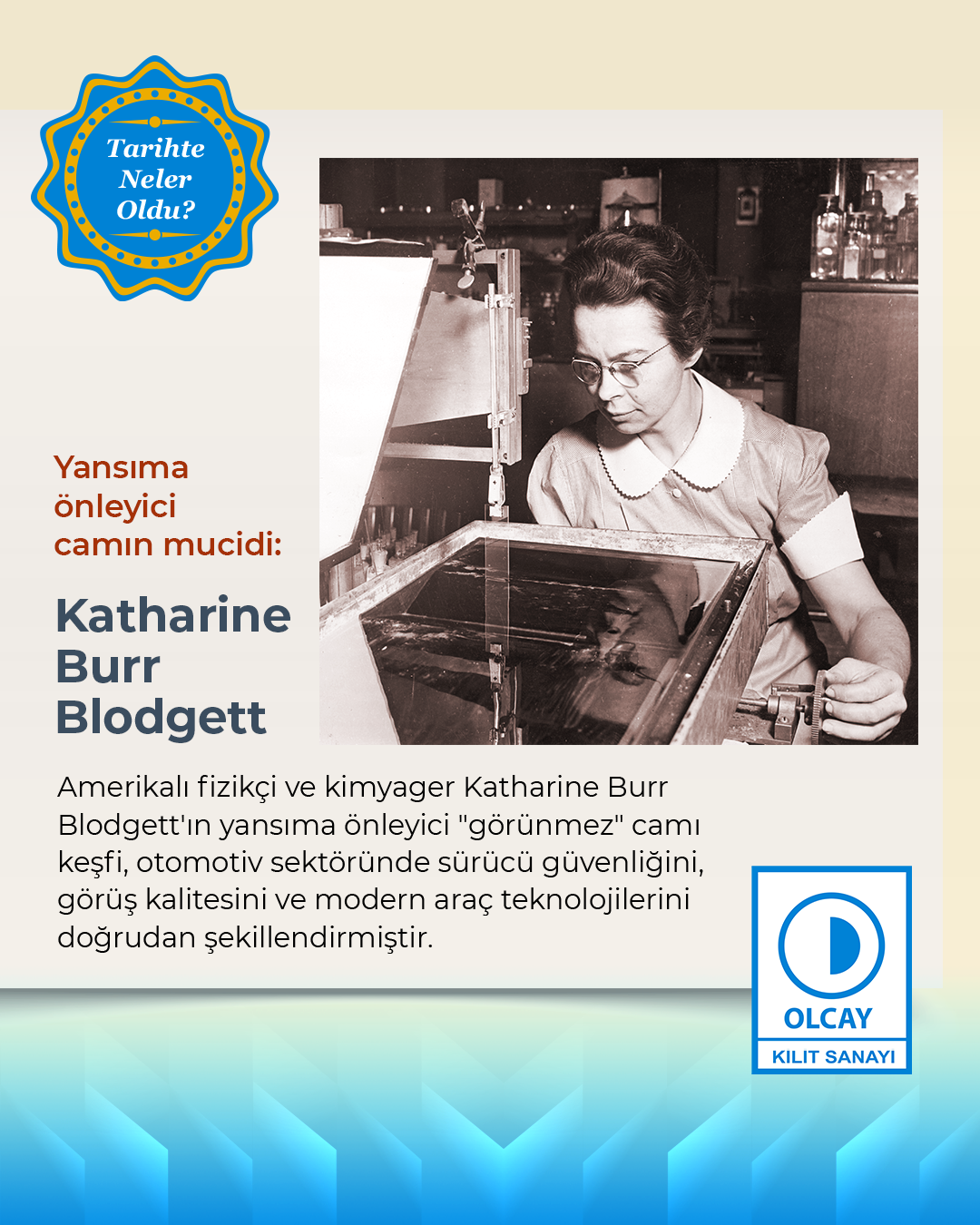


The inventor of anti-reflective glass - Katharine Burr Blodgett
What Happened in History?
The
discovery of anti-reflective “invisible” glass by American physicist and
chemist Katharine Burr Blodgett has directly shaped driver safety, visibility,
and modern vehicle technologies in the automotive industry.
Katherine Burr Blodgett, the name
behind “anti-reflective glass and lens” technology—an indispensable part of
modern automotive technology—was born in New York in 1898. In 1918, she earned
a master’s degree in chemistry from the University of Chicago. She then became
the first female scientist at General Electric, working as a research assistant
to Irving Langmuir. In 1926, she also became the first woman to earn a Ph.D. in
physics from the University of Cambridge. In 1935, building on a discovery
Langmuir had made years earlier, she developed multilayer anti-reflective
coatings for glass. With this, Blodgett successfully produced the world’s first
completely transparent glass, or “invisible glass.”
The Langmuir-Blodgett technique was
patented in 1938 and has remained essentially unchanged since Blodgett’s
discovery. This technique eliminated distortion caused by reflected light in
various optical devices and has been used in numerous products, including
eyeglasses, telescopes, microscopes, windshields, televisions, computer
monitors, and camera and projector lenses. Today, this revolutionary invention
is used in the automotive industry to:
- Improve the driver’s field of
vision by reducing glare caused by oncoming headlights at night and sunlight
during the day.
- Ensures that the cameras, radar,
and LiDAR lenses in ADAS (Advanced Driver Assistance Systems) found in
autonomous and modern vehicles operate flawlessly without being affected by
reflections.
- Prevents reflections on in-vehicle
digital infotainment screens and head-up displays (HUDs).
Blodgett also worked on techniques to
prevent icing on aircraft wings—which inspired both the aviation and automotive
engineering sectors—and contributed to maintaining surface performance under
challenging weather conditions.
Katharine Blodgett, who retired from GE in
1963, was honored with numerous prestigious awards, including the Garvan Medal
and the Medal of Progress, until her passing in 1979.
We pay tribute with respect to all the
pioneers who pushed the boundaries of engineering and inspired innovation and
the technologies of the future!
Kaynak / Source:
KPMG-Otomotiv Sanayii Derneği / Otomotiv
Sanayisinde Teknolojide Kilidi Kırmak